The Public Good, Civic Heritage, and Contested Monuments
· 10 min read
TL;DR;
- Third path. Not "take it down" or "honor heritage"—keep them, understand them, and remain vigilant against tyranny.
- Not just about the South. Oppression isn't only Southern; the capacity to repress is universal—so is unity and liberty.
- We've seen it work. Estonia (Maarjamäe), Richmond (The Valentine), and Bristol (Colston) already do "retain and explain."
- How it could look in the US. A shared fact-based plaque plus a site-specific one, both with the vigilance call; an example is below.
Why these monuments still matter
If you live in a place with a Confederate statue, a colonial conqueror on a horse, or a leader from an authoritarian regime, you already know the pattern.
One group says: "Tear it down. We shouldn't be honoring this."
Another group says: "Leave it alone. It's our heritage."
Both sides react to the same thing: a piece of stone or bronze that carries a message in public space. The question is: what message?
Our approach starts from a blunt observation:
Every generation has people who would oppress others.
That's not a quirk of the 1860s American South, or of any one ideology or nation. It's a pattern in human history. Which means the real question is not just what do we do with this statue? but what do we want future generations to see when they stand here?
We can:
- pretend the past was noble,
- pretend it never happened, or
- tell the truth and stay vigilant.
We choose the third path.
Vigilance, not nostalgia
When many of us hear "Eternal vigilance is the price of liberty," we picture foreign enemies or an overreaching government. That's real, but it's not the whole story.
We also have to stay vigilant against our own capacity to oppress: the comfortable majority that decides some neighbors don't count, the stories that dress up cruelty as honor, the policies that look "normal" on paper and devastating in practice. Part of that vigilance is understanding how people once justified what they did—what stories, myths, and numbers made it feel acceptable at the time.
Jefferson Davis fought to preserve slavery. That was only about 165 years ago. People have not changed that much since then. Millions of ordinary men and women once believed that system was just—or at least acceptable. The majority can be wrong. That's not ancient history; it's a warning label on us.
So instead of asking a monument to do something it can't - stand in for pride or shame on its own - we can ask it to:
Remind us that oppression and authoritarianism recur, and that we have to stay awake.
That means:
- We do not leave these monuments standing as unchallenged honors.
- We do not erase them so thoroughly that we can pretend we'd never do such a thing.
- We do keep them (or their trace), and we say out loud why they're still here.
This is where Civic Heritage · Never Again comes in.
A shared sentence on every plaque
Part of the problem with ad‑hoc "context" is that it varies wildly. One site gets a careful explanation; another gets two vague sentences about "complex history." A third gets nothing at all.
The Civic Heritage approach makes one thing non‑negotiable:
every Civic Reminder plaque carries the same core statement.
Here it is in full:
The cause depicted here was not honorable, but the individual(s) involved believed it was. They thought they were heroic." "Every generation has those who would oppress others. We keep this place to remember: vigilance is the price of liberty.
That statement does a lot of work:
- It names the pattern: every generation has would‑be oppressors.
- It explains the choice: we keep this place on purpose.
- It anchors the idea in a familiar phrase: vigilance is the price of liberty.
- It makes the stance explicit: we do not honor the cause; we use the site as a warning.
From there, each community can add facts and local context. But the purpose is no longer ambiguous. The monument is not there to celebrate the cause; it is there to help us stay awake to the possibility that we could repeat it.
And importantly, this isn't just about one region or one evil. Slavery and white supremacy are real, specific wrongs. So are colonial violence, ethnic cleansing, and political terror. Americans are not the only people in history who have repressed others. The potential for repression is universal. So is the possibility of unity - of choosing to remember and stand together, instead of comforting ourselves that only "they" would ever do such things.
Places that are already doing this
If this still feels too idealistic, it may help to see where similar ideas are already in use.
Estonia: "It is dangerous to think…"
In Tallinn, the Estonian History Museum gathered 21 Soviet‑era monuments into an outdoor exhibition at Maarjamäe Palace. The sculptures are still there. They have not been melted down or hidden away.
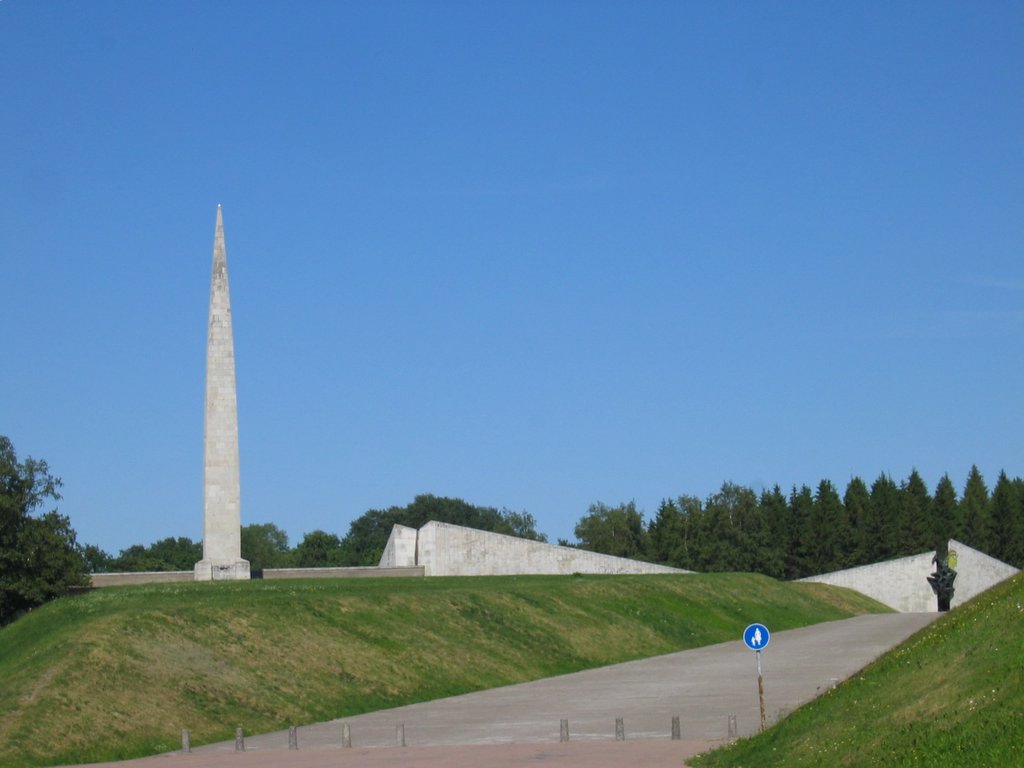
Maarjamäe War Memorial area, Tallinn. Photo: Rudi K, CC BY-SA 2.0.
The framing quote, from President Lennart Meri in 1999, is blunt:
"It is dangerous to think that the time of Stalins and Hitlers has passed."
The message is not "this era was glorious" or even "this was complicated." It's: don't kid yourself. The time of such people is never entirely gone. The monuments stay, and they now speak as warnings.
Richmond: exposing the myth
In Richmond, Virginia, the toppled Jefferson Davis monument and other Confederate sculpture now live in The Valentine museum. The exhibition title tells you the angle:
"Sculpting History at the Valentine Studio: Art, Power, and the 'Lost Cause' American Myth."
The statues are shown alongside documents that explain how the Lost Cause story was constructed and sold to the public. The point is to expose the myth, not to bathe it in nostalgia. The objects haven't vanished; their meaning has been flipped from honor to cautionary history.
Bristol: the empty plinth and the plaque
In Bristol, England, the statue of slave‑trader Edward Colston was pulled down in 2020 and is now in a museum with its protest graffiti intact. The plinth in the city center did not stay blank. It now carries a plaque that simply states the facts: who Colston was, his role in the enslavement of African people, the toppling of the statue, and where it is now.
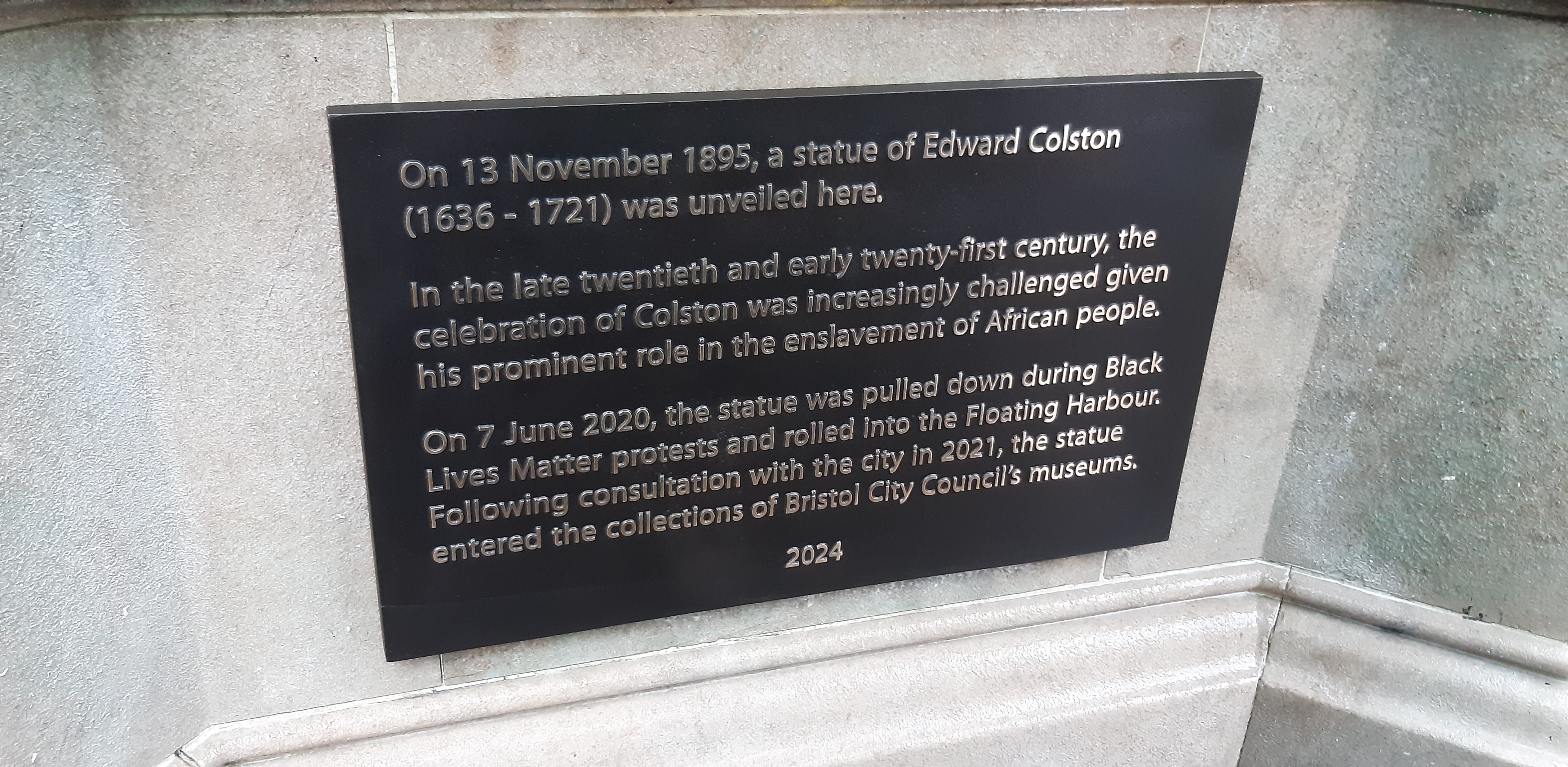
The empty plinth in Bristol city center with the new explanatory plaque (2025).
The UK approach is often called "retain and explain." The Civic Heritage approach takes that one step further: we would add the vigilance statement to that plinth, so the purpose is not only to explain the past but to commit, as a people, to not repeating it.
How this would look on the ground in the US
So what does this actually mean at a courthouse square, a traffic circle, or a former monument site?
Think in two layers:
-
A shared facts plaque.
A short, generalized plaque that can appear at many sites, with vetted numbers and dates:- Civil War years and death toll.
- The 1860 count of enslaved people (nearly four million).
- When most Confederate monuments actually went up (1890s–1920s and 1950s–1960s, in the middle of Jim Crow and the Civil Rights era).
- Lynchings during Jim Crow (at least 4,743, with 3,445 Black victims).
All of that sits under the vigilance statement.
-
A site‑specific plaque.
A second, shorter plaque for each monument or plinth that answers four questions:- Who or what is depicted?
- When was it put up?
- Who put it there?
- What cause or message was it meant to promote?
Both plaques are anchored by our vigilance statement.
One concrete example: a former Jefferson Davis monument
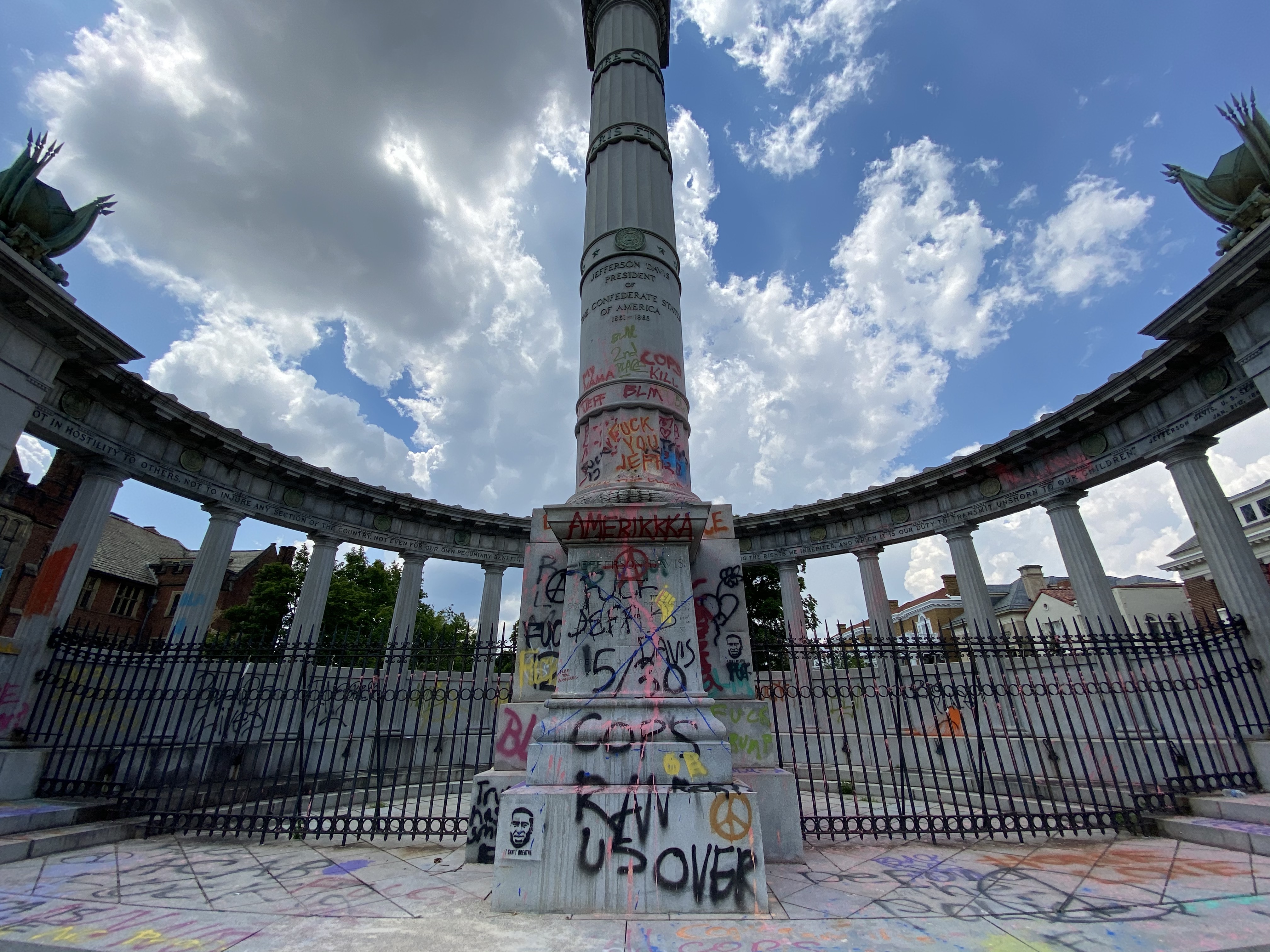
Jefferson Davis monument being removed from Monument Avenue, Richmond — the kind of site a Civic Heritage plaque would reinterpret as a warning rather than an honor. Photo: Mk17b, via Wikimedia Commons, CC BY-SA 4.0.

Imagine you're standing at a plinth where a Jefferson Davis statue used to stand. The figure has been moved to a museum. The base remains.
You look down and read:
The cause depicted here was not honorable, but the individual(s) involved believed it was. They thought they were heroic." "Every generation has those who would oppress others. We keep this place to remember: vigilance is the price of liberty.
A monument to Jefferson Davis (1808–1889), president of the Confederacy, stood here from [year erected] to [year removed]. It was erected to celebrate the Confederacy and the "Lost Cause" myth that defended slavery and white supremacy. The monument was removed in [year]; the figure is now in [museum name] so it can be seen in context.
The U.S. Civil War lasted from 1861 to 1865. In 1860, nearly four million people were enslaved in the United States. The Confederacy fought to preserve and expand that system. Most Confederate monuments were not built in the immediate aftermath of the war; they went up in two waves—the 1890s–1920s (Jim Crow) and the 1950s–1960s (Civil Rights)—to reinforce white supremacy and to teach a sanitized past. From 1882 to 1968, at least 4,743 lynchings were documented (3,445 of the victims Black). We keep this history visible so we remain vigilant. We do not honor the cause.
That's the whole idea in one place: purpose and warning, the local facts, and the broader history. A closing line ties it all the way back to vigilance.
Any proposed text like this should go through a public comment process - people get to see the draft, react to it, and push on details before it's finalized. But the core sentence about vigilance does not change from site to site. That's our spine.
Why this isn't just semantics
It's easy to hear all this and think, "Okay, plaques. Words. Does that really change anything?"
Here's why the framing matters.
1. It defends everyone from the tyranny of the majority
Keeping these sites and stating plainly that the majority can be wrong does something powerful in public space: it admits that "we" have been wrong before, at scale.
Instead of a statue silently telling you, "This was noble," the site now says:
- A lot of people once thought this was right.
- They were wrong.
- We're capable of being that wrong again.
That's not comfortable for anyone on any side of today's debates - exactly why it's useful. It makes it harder for any temporary majority - left, right, or otherwise - to convince itself that its own power is automatically and completely righteous.
2. It makes us harder to manipulate from outside
Authoritarian regimes and hostile actors invest heavily in one thing: division. They do well when we tell ourselves two lies:
- "Our side has clean hands."
- "The other side is uniquely wicked."
A country that remembers its own capacity for wrong - and that keeps that memory visible at the very sites where it once honored oppressors - is a harder target.
If the public story at those sites is, "We are capable of terrible things, and we're determined not to repeat them," it's much tougher to weaponize those monuments into simple culture‑war totems.
A hard but necessary task
None of this is easy.
For some, the idea of keeping any trace of these monuments feels like salt in an open wound. For others, the idea of adding plaques that call their "heritage" a warning feels like an attack.
And yet: we have done hard things together before.
We have acknowledged wrongs, changed laws, taken down flags, and rewritten textbooks. We have also, at times, tried to skip the hard part - pretending the past was either pure or irrelevant, and then watched as the same patterns return in new clothes.
We have an opportunity to do something else, something meaningful:
- Tell the truth in public.
- Keep the reminders where people can see them.
- Say, out loud, that we're not going to sleepwalk into this again.
It may be difficult for people across the political spectrum. But we aren't a fragile people. We don't have to choose comfort over clarity. We are strong enough for the truth.
Eternal vigilance is the price of liberty. These sites are where we say that - not as a slogan, but as a public purpose and commitment.